
Omega
Why EPA and DHA Omega-3s Are Non-Negotiable for Brain Health
Most people think they need more omega-3s in their diet.
But more importantly, most aren’t getting the right kind of Omega-3s.
Not All Omega-3s Are Created Equal
There are three primary types of omega-3 fatty acids:
ALA (alpha-linolenic acid) → found in flax, chia, hemp
EPA (eicosapentaenoic acid) → found in fatty fish
DHA (docosahexaenoic acid) → found in fatty fish and algae
Here’s the critical distinction:
ALA is not a brain omega-3.
Your body must convert ALA → EPA → DHA.
That conversion is extremely inefficient (often <5% for EPA and <0.5% for DHA).
So yes, flax and hemp are “omega-3 foods”…
But they do not meaningfully supply the brain and body with EPA and DHA.
If your goal is neurological protection, recovery, and performance:
You need EPA and DHA. Directly.
DHA: The Structural Fat of the Brain
DHA is not just another nutrient.
It is a primary structural component of neuronal membranes.
Critical for synaptogenesis (forming new connections in the nervous system)
Supports membrane fluidity and signaling
Essential for neurodevelopment and brain repair
This is why:
DHA is included in every prenatal formula
Low DHA is associated with cognitive decline and mood disorders
Your brain is always doing one of two things:
Breaking down or building up.
DHA pushes you toward repair, resilience, and regeneration.
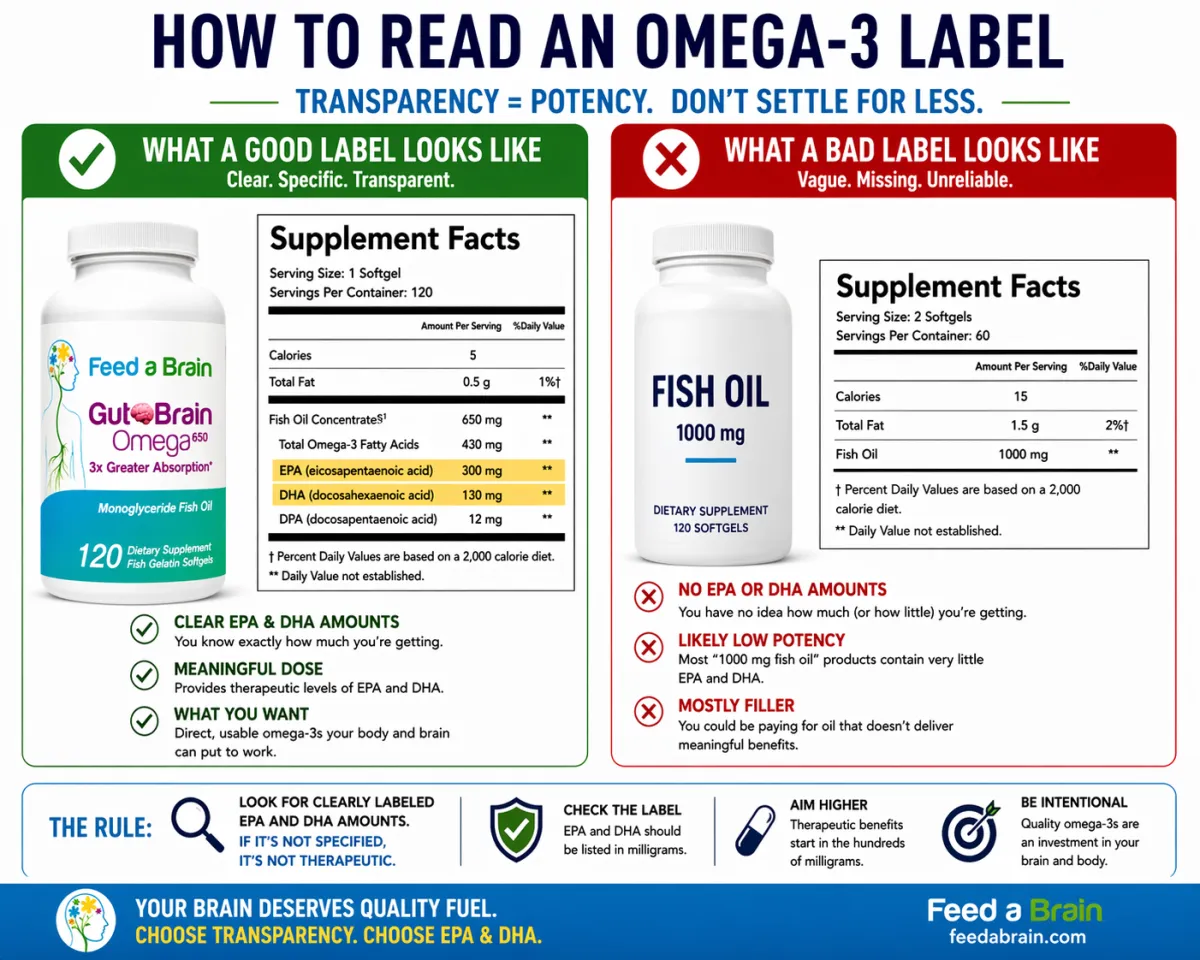
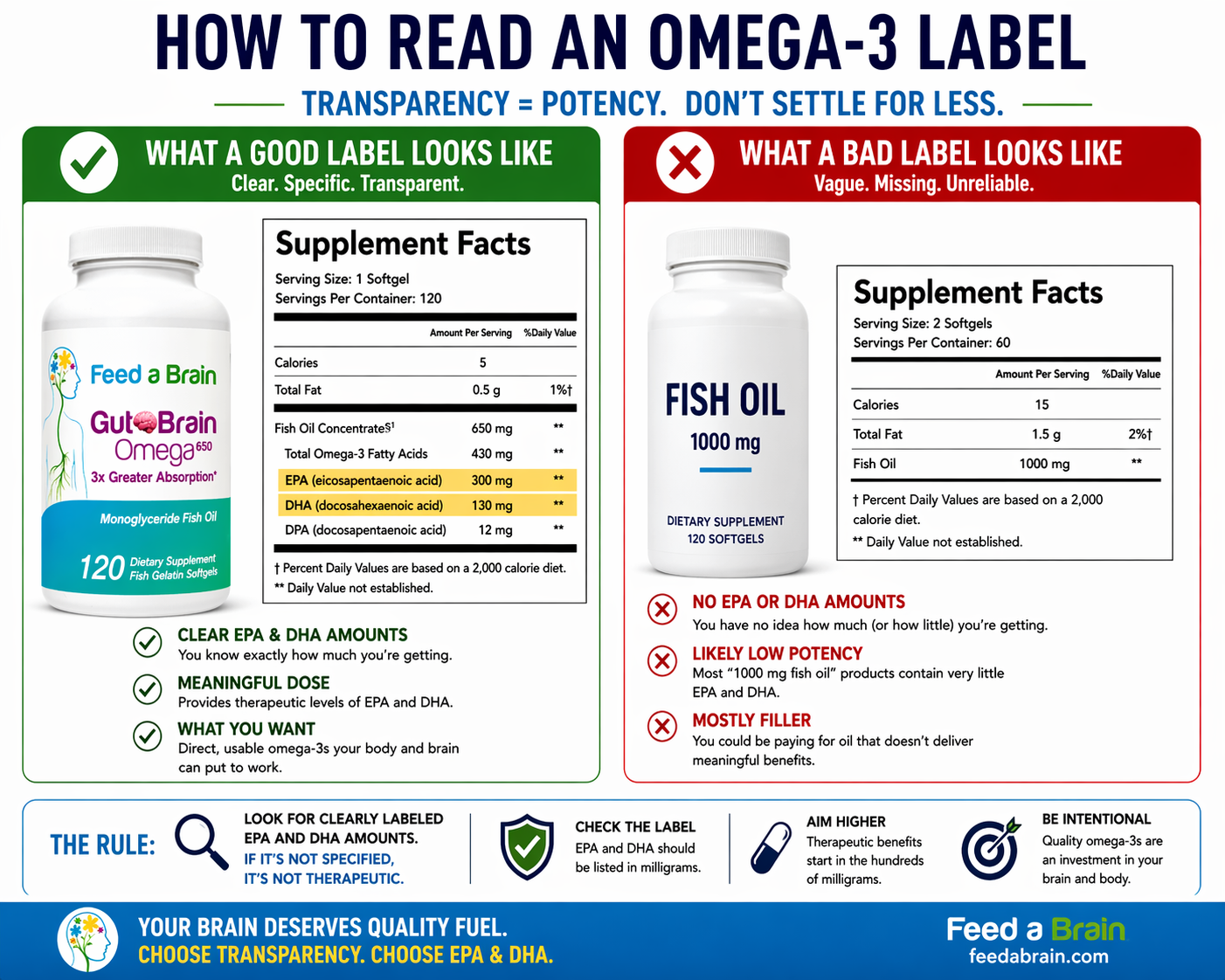
If Your Fish Oil Doesn’t List EPA and DHA… It’s Not Worth Taking
This is where most supplements fail.
If a label says:
“Fish oil 1000 mg”
…but does not clearly list EPA and DHA content…
You have no idea what you’re getting.
And in many cases, it’s negligible.
Rule:
Look for clearly labeled EPA + DHA amounts
Aim for meaningful dosing, not filler oil
If it’s not specified, it’s not therapeutic.
DHA and EPA in Traumatic Brain Injury (TBI)

This is where omega-3s move from “healthy” to clinically powerful.
Human Case Insight
A published case in the American Journal of Emergency Medicine describes a teenager with:
Severe traumatic brain injury
Diffuse axonal injury
Glasgow Coma Scale = 3 (lowest possible)
He was given high-dose fish oil via feeding tube (≈30 mL/day).
Outcome:
Weaned off ventilator by day 21
Recovered to attend his high school graduation within months
This is not theoretical.
This is applied clinical nutrition.
https://doi.org/10.1016/j.ajem.2012.05.014
Mechanism: Why EPA and DHA Matter After Brain Injury
Reduce neuroinflammation
Lower oxidative stress
Support cell membrane repair
Promote neuroplasticity and recovery
In both animal and human data:
DHA reduces severity of brain injury
Pre-injury DHA status improves resilience to damage
This is relevant for:
Athletes
Military personnel
Anyone at risk of head trauma
“What About Blood Thinning?”

This is one of the most common clinical concerns.
Here’s what the literature actually shows:
High-dose omega-3s are generally safe, even alongside medications like aspirin and warfarin
DHA up to ~6 g/day shows no harmful effects on clotting in normal individuals
Some platelet inhibition occurs, but this can be beneficial in many populations
Clinical nuance:
Use caution in active bleeding or pre-surgical settings
Otherwise, the fear is largely overstated relative to the benefits
Many Clinicians are afraid to use high-dose omega-3s because of their blood thinning effects. This paper addresses this concern and shows much evidence to support the use of high-dose fish oils as a treatment for brain injury:
Omega-3 Fatty Acids as a Putative Treatment for Traumatic Brain Injury
“…Potential harmful effects of n-3 PUFAs [omega-3s], however, have been described in the literature. Due to the established anti-thrombotic action of these compounds, for instance, they may increase the risk of hemorrhagic stroke, as suggested by a necropsy-based study of four cases in Greenland.138 The authors warn, however, that the power of their analysis is weak given the limited sample size, and that their study may have been subject to inadvertent selection bias.138 In addition, multiple clinical trials have shown that highdose fish oil consumption is safe, even in patients receiving other agents that may increase the risk of bleeding, such as aspirin and warfarin.139–141 The overall clinical data suggests that DHA at doses up to 6 g/day does not have deleterious effects on platelet aggregation or other clotting parameters in normal individuals, and fish oil does not augment aspirin-induced inhibition of blood clotting.137 Platelet function is, on the other hand, inhibited by DHA consumption in type 2 diabetics, but it is suggested that this may actually be of benefit to these individuals, especially when coupled with the other activities of DHA.142 Nevertheless, it may be prudent to discontinue high-dose supplementation in the setting of an acute bleeding illness or in patients at high risk for hemorrhagic stroke or, as is frequently recommended with aspirin, warfarin, and clopidogrel, prior to planned invasive procedures with the highest risk for bleeding complications.143–146″
TLDR: Summary of the above article
In other words, while Omega-3’s have been shown to thin the blood, this was mainly shown by a study that the authors admit is somewhat weak because of a small sample size and selection bias.
Several other studies have shown high-dose fish oil consumption to be safe, even in patients who are receiving other blood thinners like warfarin and aspirin.
And up to 6g/day of DHA does not cause harm on clotting parameters in normal individuals, nor does it change aspirin-induced inhibition of blood clotting.
From the Abstract of this paper: Lien EL. (2009). Toxicology and safety of DHA. Prostaglandins Leukot Essent Fatty Acids 81, 125–132.
“DHA supplementation studies in adults have employed doses ranging from less than 1 to 7.5g/d, and have not resulted in any consistent adverse responses in platelet function, lipid levels, in vivo oxidation parameters, glycemic control, or immune function.”137
Acute vs Long-Term Use
Acute (Brain Injury, Stroke, Severe Inflammation)
Higher, therapeutic dosing (often liquid forms)
Used as an adjunct therapy
Long-Term (Everyone Else)
Daily intake supports:
Cognitive clarity
Mood stability
Neuroprotection
Aging resilience
You don’t need a brain injury to benefit from brain nutrients.
Practical Application
Food First
Wild salmon
Sardines
Mackerel
Anchovies
Supplement Support
For consistency and therapeutic dosing:
Use a high-quality omega-3 with clearly labeled EPA and DHA
Prefer forms with enhanced absorption (monoglyceride or re-esterified triglyceride forms)
A simple baseline approach:
1 capsule with each meal
Final Perspective
Your brain is not static.
It is either:
inflamed or resolving inflammation
degenerating or regenerating
EPA and DHA shift the terrain toward healing, structure, and function.
If you’re serious about:
Brain performance
Recovery
Long-term cognitive health
This is not optional.
It’s foundational.
Omega-3’s and Traumatic Brain Injury Treatment
Want the takeaways on omega-3s and blood thinning? Read the TLDR of the research below.
What About the Risk of Blood Thinning?
Many Clinicians are afraid to use high-dose omega-3s because of their blood thinning effects. This paper addresses this concern and shows much evidence to support the use of high-dose fish oils as a treatment for brain injury:
Omega-3 Fatty Acids as a Putative Treatment for Traumatic Brain Injury
“…Potential harmful effects of n-3 PUFAs [omega-3s], however, have been described in the literature. Due to the established anti-thrombotic action of these compounds, for instance, they may increase the risk of hemorrhagic stroke, as suggested by a necropsy-based study of four cases in Greenland.138 The authors warn, however, that the power of their analysis is weak given the limited sample size, and that their study may have been subject to inadvertent selection bias.138 In addition, multiple clinical trials have shown that highdose fish oil consumption is safe, even in patients receiving other agents that may increase the risk of bleeding, such as aspirin and warfarin.139–141 The overall clinical data suggests that DHA at doses up to 6 g/day does not have deleterious effects on platelet aggregation or other clotting parameters in normal individuals, and fish oil does not augment aspirin-induced inhibition of blood clotting.137 Platelet function is, on the other hand, inhibited by DHA consumption in type 2 diabetics, but it is suggested that this may actually be of benefit to these individuals, especially when coupled with the other activities of DHA.142 Nevertheless, it may be prudent to discontinue high-dose supplementation in the setting of an acute bleeding illness or in patients at high risk for hemorrhagic stroke or, as is frequently recommended with aspirin, warfarin, and clopidogrel, prior to planned invasive procedures with the highest risk for bleeding complications.143–146″
TLDR: Summary of the above article
In other words, while Omega-3’s have been shown to thin the blood, this was mainly shown by a study that the authors admit is somewhat weak because of a small sample size and selection bias.
Several other studies have shown high-dose fish oil consumption to be safe, even in patients who are receiving other blood thinners like warfarin and aspirin.
And up to 6g/day of DHA does not cause harm on clotting parameters in normal individuals, nor does it change aspirin-induced inhibition of blood clotting.
From the Abstract of this paper: Lien EL. (2009). Toxicology and safety of DHA. Prostaglandins Leukot Essent Fatty Acids 81, 125–132.
“DHA supplementation studies in adults have employed doses ranging from less than 1 to 7.5g/d, and have not resulted in any consistent adverse responses in platelet function, lipid levels, in vivo oxidation parameters, glycemic control, or immune function.”137
Liquid Omega-3’s and Traumatic Brain Injury Treatment
This article is about how to use liquid omega-3’s as an adjunct therapy to help with brain injury, and other cases of severe brain inflammation. Moderating inflammation and oxidative stress in the brain after a traumatic brain injury or an ischemic injury like stroke is critical. Omega-3’s are a low-risk therapy that can help thousands of veterans and civilians alike.
A Case for Using Liquid Omega-3’s
High-dose N-Acetyl-Cysteine (NAC) is used in hospitals when someone may have overdosed on Tylenol because it has been found that NAC cleans out a liver that an overdose has burdened. Large quantities of research back this use of NAC in the treatment of Tylenol overdose.
Omega-3s have a similar record in regard to anti-inflammatory effects and reduction in oxidative stress in the body.
Liquid Omega-3’s helped JJ Virgin’s son recover from a traumatic brain injury. A little oxidative stress in the brain is a good thing, but prolonged oxidative stress can lead to cell death or apoptosis.
CNN Piece About JJ Virgin’s Son:
Omega-3’s Can Reduce Brain Injury Severity
After finding very favorable results in a study testing the use of DHA after a severe traumatic brain injury (diffuse axonal injury) in rats (CITE), the West Virginia University School of Medicine conducted a follow-up study to see the effect of DHA supplementation before a brain injury.
The study found that rats who were supplemented with DHA before a brain injury showed less damage done to the brain after, as well as better brain function, as assessed by maze testing. (CITE)
Using Liquid Omega-3’s in Gastric Feed
Supplementation and whole food sources may be the most effective way to deliver this vital nutrient to patients with a gastric feed.
When feeding through a gastric tube, blend fatty fish and liquid Nordic Natural UltimateOmega in a blender to create a nutrient-dense feed.
High-powered blenders like Blendtec or Vitamix are the most effective at breaking down whole foods and capsules into the consistency necessary for gastric feeding tubes.
For vegans and vegetarians, we can blend Nordic Naturals – Algae Omega for a good source of EPA and DHA.
Because cod liver oil is rich in many other fat-soluble vitamins, such as vitamin A, cod liver oil may not be appropriate at therapeutic (very high) doses.
Fat-soluble vitamin A is great, but at high doses, it can cause hypervitaminosis. Reach out to a qualified practitioner like Cavin for support and guidance.
Read our Ready Made Solutions for Gastric Feeds to learn the details.
Adding Omega-3s to Your Supplement Regimen:
Gut🧠Brain Omega – 3x Greater Absorption
Omega-3 Dosages
While therapeutic (very high) doses of Omega-3s can be beneficial in an acute head injury, we don’t need to have abraininjury to experience the massive benefits of
DHA and EPA for brain health.
In addition to eating plenty of cold water fatty fish, I also supplement with 1 capsule of Gut🧠Brain Omega with each meal. Not only is Gut🧠Brain Omega 3x more absorbable than other fish oils, but it also enhances the absorption of other fats, making it a ketogenic powerhouse!
For a vegetarian source, Nordic Naturals – Algae Omega can be supplemented. Check with your qualified healthcare practitioner for amounts specific to you or your loved one.
Docosahexaenoic Acid (DHA) for Synaptogenesis
DHA is a kind of Omega-3 fatty acid that is largely found in fatty fish like mackerel, sardines, salmon, and tuna. As shown above, there are studies showing the use of Omega-3s in the waking of comatose patients.
Because it seems to have an extremely potent effect on neurological recovery and in protecting the brain, not only are sports leagues very interested in Omega- 3s and their effects in preventing and treating brain injury, but scientists in the military are also inspecting this nutrient for brain injury treatment and neuroprotection.
In 2011, an article in Military Medicine, the official journal of The Association of Military Surgeons of the United States (AMUS), wrote that “a comprehensive, coordinated research program to evaluate the multiple uses of n-3 FA [Omega-3 fatty acids] should be a high priority for the Department of Defense.“ (CITE)
Read Our Full Article on DHA to learn about the specific benefits of this precious omega-3.
Read more about the importance of DHA and Omega-3.
Omega-3s for Daily Optimal Brain Function and Repair:
Capsules:
Feed a Brain Protect and Restore High DHA Omega
Vegan Capsules:
Fish Sources:
Vital Choice Seafood and Organics
Alleviating Blood Thinning Concerns Citations
137. Lien EL. (2009). Toxicology and safety of DHA. Prostaglandins Leukot Essent Fatty Acids 81, 125–132.
139. Pedersen HS, Mulvad G, Seidelin KN, Malcom GT, and Boudreau DA. (1999). N-3 fatty acids as a risk factor for haemorrhagic stroke. Lancet 353, 812–813.